




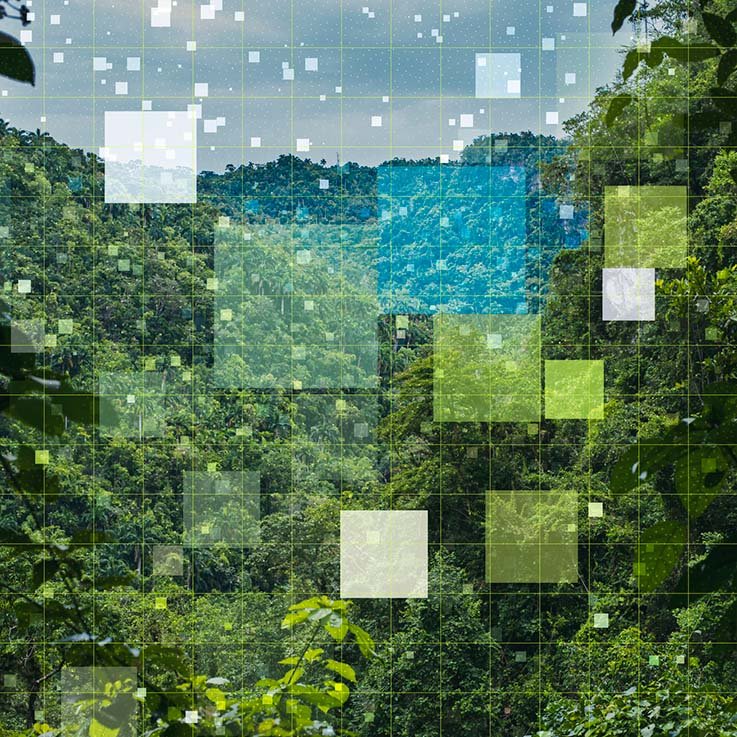

(Photo by iStock/wayra)
With rapid advances in artificial intelligence, many of us living in societies dominated by Western science are becoming increasingly aware of other forms of intelligence living alongside us. Animals, plants, and natural systems have revealed their complexity and knowledge, even as our technologies threaten their extinction.
Practices for Transitions in a Time Between Worlds
There is no manual for living through our wildly unpredictable times. How do we imagine, prepare for, and shape an unknown future? Who do we need to be or become? Instead of a road map, we offer this supplement to illuminate inquiries, capacities, and practices that we believe can open consequential new pathways to a better tomorrow. Sponsored by Joseph Rowntree Foundation
Several movements around the world are working to give legal and political standing to nonhuman beings by recognizing legal personhood and creating “parliaments of things,” for example, whereby nonhumans are granted a voice, albeit a voice ventriloquized by humans. Most of these approaches extend existing systems of human governance without fundamentally changing the system, however. To meet the natural world in all its complexity, we must do more than reformulate the dominant culture’s prejudices using novel language. “Rights of nature” must be acknowledged as already existing.
There are several ways to approach this challenge:
- Using technology to better understand nonhuman lifeways so that we might change our ways to accommodate their ways (e.g., using sensors to apprehend needs and desires, and adjust human patterns of life).
- Embracing nonlinguistic modes of communication: We’re overly focused on language, ignoring the many other ways that nonhumans communicate, including movement, gesture, and spiritual connection.
- Practice cooperation: Instead of focusing on how to communicate or to make decisions in the abstract, we must work together with nonhumans to identify and pursue common goals.
Based on these points and the ideas in my book Ways of Being, I am developing Server Farm to engage with planetary intelligence, new forms of computation, and new forms of law and governance. Server Farm is building a new computer to accommodate the more-than-human intelligence all around us—including animals, plants, and ecosystems—to address some of the thorniest problems we face. The nonhuman world is filled with superhuman abilities: Consider the calculating powers of slime molds, the electrochemical sensibilities of fungi, the subterranean signaling of plants and trees, and the wayfinding abilities of birds and bees. Undoubtedly, there is more waiting to be revealed.
Server Farm seeks to understand and engage with more-than-human intelligence on its own terms through collaboration and cooperation, not domination. Nonhuman beings are not resources to be exploited. This means that a new computer must embody new ways of being and working together. Communication, justice, and equality are key concerns in its operations, and shape the questions we can ask and answer. A system that is not in harmony and geared toward mutual flourishing will cease to function. Server Farm is not just a prototype of a new computer, but also an attempt to articulate a broader framework for ethical and regenerative life.
Support SSIR’s coverage of cross-sector solutions to global challenges.
Help us further the reach of innovative ideas. Donate today.
Read more stories by James Bridle.

